Father Brown
Created by: G.K Chesterton


Blending in with the crowd, nothing about
Father Brown stands out. He looks just like your common
roman catholic priest with a short stature bringing a trusty
umbrella. Don't let this unremarkable presence fool you though
as within his mind lies a sharp intelligence that unravels
mysteries using his insights in Human Psychology. Unlike the
traditional detectives who use deductions to solve crimes,
Father Brown tries to understand the psychological
reasoning and rationale behind the act as he believes that
there is a human reason behind every sin. As a priest, he also
of course believes in the reformation and redemption of
criminals. A good living example is his occasional sidekick,
Flambeau, a french criminal turned private
investigator.
I find the Father Brown stories to be a bit of a mixed
bag. The concept of Father Brown himself is an
interesting one, a detective that is also a priest who uses
empathy and reforms criminals sounds cool but the stories
don't really utilize that aspect much... (or at least not from
what i read so far) The writing itself also fittingly enough i
guess gets "preachy". Chesterton often pokes fun at
athiests and "intellectuals" in the stories and it just comes
off a bit much. Even Chesterton, himself, apparently
admits that he may have "written some of the worst mystery
stories in the world" due to most of the
Father Brown stories being hastily written to make
money. Despite all of this though, there are tales of
Father Brown worth reading and it can't be denied that
he is one of the pioneers in literature for solving crimes
through psychological means and for the
unlikely/underestimated detective trope that others like Miss
Marple, Kosuke Kindaichi, and
Lt. Columbo to name a few, also
follows.
Books
G.K Chesterton has written 53 Father Brown short stories.
12 of 53 stories read (23%)The Wisdom of Father Brown
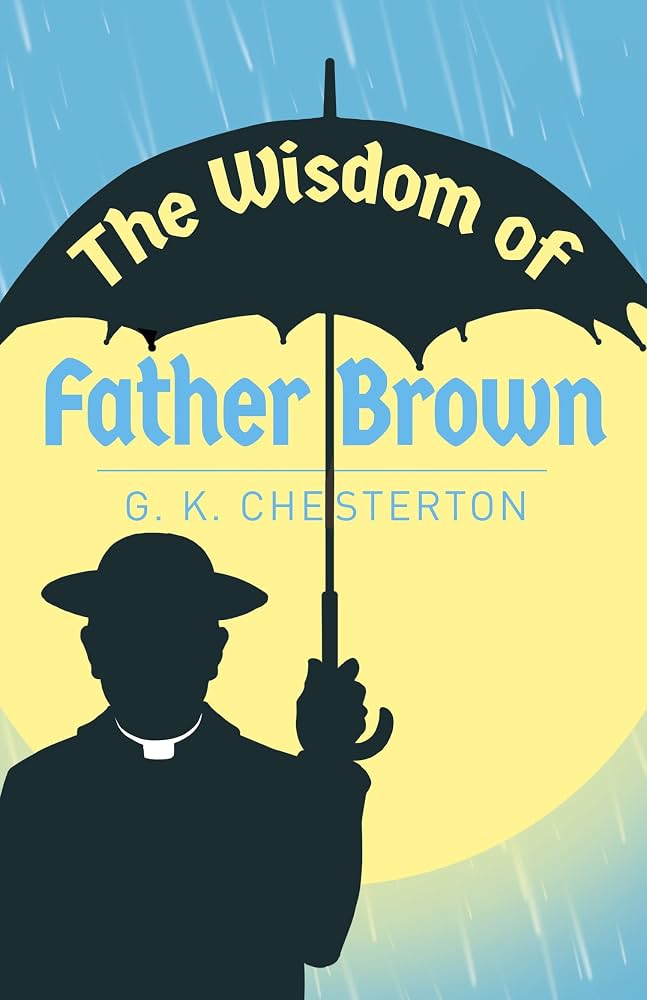
This is the second compilation of Father Brown short-stories. Was fortunate enough to find a copy in one of the local bookstores here.
Absence of Mr. Glass
Orion Hood, a criminologist, is visited by Father Brown, who asks for his help in solving the affair of the MacNabs. Maggie MacNab the young lady of the family wants to marry a young man named James Todhunter, but her mother refuses to allow them due to Todhunter's sketchy occupation which he refuses to disclose and his apparent association of a strange tall man with a silk hat named Mr. Glass
An amusing short story, it's essentially a joke told in the form of a mystery narrative. This story also highlights the difference in how Father Brown solves mysteries since Orion Hood's whole character is a poke Sherlock Holmes. Overall It's "meh", it's not boring but there's not much substance to this story, again it's pretty much just a joke just with a lot of fluff and flavor set up before the punchline.
The Paradise of Thieves
Muscari a young Tuscan poet meets an old friend, Ezza, who is now working as a courier for the Harrogate Family. The family will be crossing a mountain path but Muscari warns that the notorious Montano, the "King of Thieves" was last seen there which could put the family at risk. Ezza reassures however, that the path is perfectly safe and Montano is merely an old tale. Listening to this discussion is Father Brown who discreetly warns the son of the family, Frank Harrogate that his sister, Ethel, will be in great sorrow.
This one i find pretty uninteresting and bland. I didn't really care much for the premise and so the twist really did nothing for me. It comes off as a weaker and milder version of something like Doyle's "The 'Gloria Scott'", which features pirates and swashbuckling action which i don't really care much for in the first place.
The Duel of Dr. Hirsch
Dr. Paul Hirsch, a scientist is being accused by a Colonel, Jules Dubosc for giving secret information about a new Noiseless Powder being developed for war to a German spy. Flambeau, Father Brown's friend offers his help in the investigation. He returns to Father Brown more confused than before as he reveals what the note discloses...
This has a great twist at the end and it was written in such a chilling way, the only problem is i find the writing on this one a bit too roundabout and it gets a bit confusing on how the scene is supposed to be intended. i didn't consider the possibility of the twist and didn't even get it initially since the writing wasn't sufficiently explicit on what exactly happened. But upon re-reading the earlier parts, it makes sense and it's a decent execution of that kind of twist.
The Man in the Passage
A famous actress Aurora Rome was stabbed in the passage leading to her room. The people she was with before her murder were her suitors: A flamboyant tall man, Sir William Seymour, a not as tall but just as handsome, Captain Cutler, her servant, Parkinson, her co-star, Isidore Bruno. Additionally, there was also a priest who she apparently requested, Father Brown. Seymour and Cutler believes that there was a strange man in the passage before her death.
Really hooked by the premise for this one, though the method it was hinting at was kinda predictable and the culprit was kind of unsatisfying. It's a high point of the book for me though and a decent read.
The Mistake of the Machine
Flambeau shares to Father Brown that a new psychometric method is being used in America (which is essentially the polygraph test). Father Brown warns that such method can be valueless as he recounts his experience with Greywood Usher, a second in-command, who used a similar method in who he believes to be a prison escapee.
Another high point of the book, it's another humorous story but this one has a more interesting premise and continues after the punchline.
The Head of Caesar
A red-haired lady, Christable Carstairs, and she shares her curious story to Father Brown. She secretly stole a coin with the face Caesar on it from her brother, Arthur Carstairs' Roman coin collection since it looked like her lover, Philip Hawker. However, once she gives the coin to Philip, she sees a suspicious bearded man with a crooked nose slowly walk to them from afar and requests for the coin.
Quite enjoyed this one as well since it has a fascinating premise and how it opens before we get the case was quite atmospheric and the twist was decent.
The Purple Wig
Edward Nutt, the editor of the Daily Reformer, reads the letter of Francis Finn, a reporter who narrates the legend of the "Devil's Ear of the Eyre" which is a curse that burdens the family of the Duke of Exmoor, the family apparently has an elf-shaped ear and wears their hair long to cover it as it brings horror to any person who witnesses it. Finn promises to the editor that he will uncover the truth behind this legend.
The best short story so far. The twist here actually got me. It's told in a creative and humorous way as well with the story being a scoop narrated by a journalist being read by the editor who hilariously edits certain words in the story after reading them to appease their readers.
The Perishing of the Pendragons
Father Brown is in a small yacht with his friend, Flambeau and a young squire, Sir Cecil Fanshaw who is about to introduce them to Old Pendragon, also referred to as the "Admiral". His family the Pendragons were cursed by an escaping Spaniard captive whose two fellow captives were killed by Sir Peter Pendragon, the remaining captive dived and was never found in the sea afterwards. More than two of the Admiral's near kin have apparently died in a shipwreck more or less close to where the Spaniard captive screamed their curse.
This one takes a bit of a while to get to the premise but it is a fun one. The reveal and the action at the climax doesn't flow quite well for me though and i had some trouble picturing the scenes being described.
The God of the Gongs
Father Brown and Flambeau encounters a peculiar bandstand while on a walk. Believing it to be a temple of some sort they investigate it, Father Brown falls down the rotten floor, and upon further investigation he believes that he has seen the "sacrifice" of the temple.
This was just downright racist and horrible. It left a horrible taste and kind of stained the Fr. Brown character for me. Recommend to skip this one. It has no redeeming quality whatsoever.
The Salad of Colonel Cray
On the way home from a mass in a misty morning, Father Brown hears a gunshot from a villa. He recognizes that it is the one owned by Major Putnam. The shot was apparently fired by his colleague Colonel Cray who is lately paranoid and believes that he is being chased by devils. What's weirder is that the target of his shot apparently sneezed after getting shot?
This was alright, the culprit was kind of predictable but it's a decent one especially compared to the last.
The Strange Crime of John Boulnois
Calhoun Kidd, an American journalist, has an appointment with a philosopher of some sort, John Boulnois. Upon reaching his home however, a servant informs him that he went out alone at Pendragon Park. Annoyed, Kidd goes to Pendragon Park and stumbles upon the dying Sir Claude Champion, a popular man who is rumored to be pining after Mrs. Boulnois. He claims that Boulnois did it before dying. The setup here was too slow, the mystery itself and the resolution were all boring and unsatisfying especially since the death breaks what is considered now as one of the most important rules in writing murder mysteries.
The Fairy Tale of Father Brown
While enjoying in the city Heiligwaldenstein, Flambeau tells the the unsolved case of the death of Prince Otto, who was "shot without a firearm" to Father Brown.
Same as the previous story, not sure if it was the stressful circumstances going on in my life that made this a very sluggish read but it feels like it take ages to get to the crux of the story and the solution wasn't really satisfying either...